How do Mecanum Wheels Work?

June 9, 2010

httpv://www.youtube.com/watch?v=o-j9TReI1aQ

It should come as no surprise that I’m a huge fan of Mythbusters. I like their “failure is always an option” maxim, meaning if you have an idea you should try it out, what’s the worst that can happen?

While watching the program one day, I noticed something weird about their forklift — it moved sideways. It didn’t just turn on a dime, but actually moved perpendicular to the direction of the wheels. Upon closer inspection, they looked more like worm gears than wheels. The answer was just a Google away: The Mythbusters’ forklift is equipped with Mecanum Wheels, also known as Omni Wheels or Ilon Wheels. These wheels work by rotating independently, depending on the desired direction of travel.

I had an idea that this might make for an interesting motion graphic (above), since still images really don’t do this technology justice. So I tried it out (what’s the worst that can happen?)
Specialized Knowledge to General Knowledge

June 8, 2010

I’ve always been into music but only recently picked up a guitar and started to learn to play. I had seen guitar tablature (or “tabs”) before, but only knew it as some sort of esoteric shorthand musical notation encoded in monospaced gibberish; a specialized language for people who had studied music and practiced guitar to some degree.

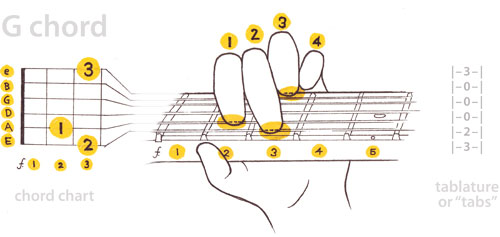
When I started browsing for the best approach to learning guitar, the first page of every book, the first image on every site, the first video in every tutorial, was always an image like this:
Reading Guitar Notation

Whether it takes the form of a drawing or marked-up photograph, this image is the standard starting point for learning to play guitar. Ignoring all other elements, the title and the image of the hand alone clearly communicate “to do this, do this.” To play the G chord, place fingers 1, 2 and 3 on strings A, E and e, in positions (frets) 2, 3 and 3, respectively.

The chord chart to the left abstracts this fingering map, representing the fingers, strings and frets in a simpler, more condensed form. It’s understood that these two images represent the same thing,”to do this, do this,” but without the fingering map the chord chart would mean nothing to the uninitiated.

The tablature (or “tabs”) on the right further abstract and condense the concept. We are presented with a column of our six strings with numbers representing the position (or frets) our fingers need to be in. The specific finger we use for each string/fret is taken for granted and omitted.

Whatever form it takes, this image is a technical illustration. It decrypts esoteric, specialized knowledge into general knowledge that any person could interpret and employ. With one image, I went from looking at a bunch of lines and numbers to music.