Caregivers’ Wishlist
Infographic (polar area pie graph) showing family caregivers’ preferences for various support programs. AARP Magazine, May/June 2010.
It should come as no surprise that I’m a huge fan of Mythbusters. I like their “failure is always an option” maxim, meaning if you have an idea you should try it out, what’s the worst that can happen?
While watching the program one day, I noticed something weird about their forklift — it moved sideways. It didn’t just turn on a dime, but actually moved perpendicular to the direction of the wheels. Upon closer inspection, they looked more like worm gears than wheels. The answer was just a Google away: The Mythbusters’ forklift is equipped with Mecanum Wheels, also known as Omni Wheels or Ilon Wheels. These wheels work by rotating independently, depending on the desired direction of travel.
I had an idea that this might make for an interesting motion graphic (above), since still images really don’t do this technology justice. So I tried it out (what’s the worst that can happen?)
If recent projects are any indication, energy is a hot topic. From advances in sustainable production, to energy independence, to efficiency and control, the issues are boiling over and innovation is gathering steam. Above: Four solar energy technologies illustrated: photovoltaic panels, solar water heating, solar power tower and passive solar heating. Right: Cutaway illustration of a new horizontal drilling technique that increases yield and reduces equipment costs and surface disturbance.
Left: If the US’ annual energy consumption was converted to coal, it would fill a 1,000 mile-long train consisting of 100,000 cars. If that coal were to be dumped on Manhattan, a 23 square mile island, the pile would be 160 feet deep. If the entire world’s energy consumption were converted to coal, the pile would be 618 feet — it would reach the 60th floor of the Empire State Building. Wind power would account for 14 inches of the pile. Solar power, a mere 10 sheets of paper thick.
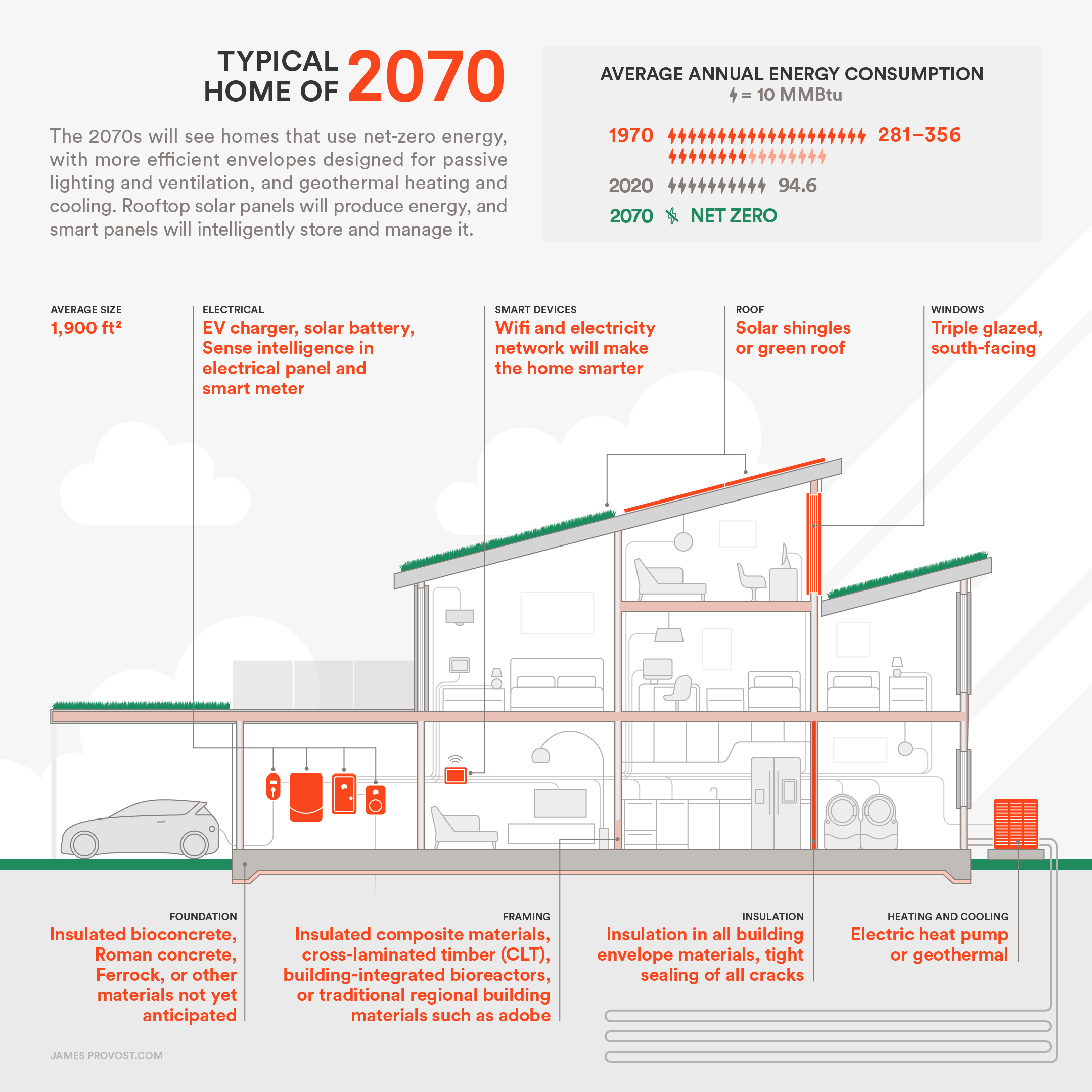
Below: Smart homes will manage energy usage, take advantage of off-peak energy, control appliances, produce energy and sell it back to the grid, and brief homeowners about their energy consumption, and encourage efficient living.
Top illustration for University of Minnesota’s Momentum Magazine. Bottom three for Missouri S&T Magazine. Big thanks to Art Directors Sarah Schmitz and Mindy Limback!
Done is the engine of more. A selection of productivity mantras illustrated, after Bre Pettis and Kio Stark’s Cult of Done Manifesto.
Carbon dioxide is a greenhouse gas that contributes to global warming. Calculate your household’s carbon footprint and discover ways to reduce your carbon output.
Infographic showing the flow of water from a ruptured standpipe through an apartment building.
If you can’t open it, you don’t own it. Mister Jalopy proposed an Owner’s Bill of Rights, a maker’s memorandum requesting repairability for the products around us. It became a manifesto for the maker community, a modus operandi for open sourcers and forward-thinking manufacturers.
Make Magazine Vol 20.
Way back in 2005, Mister Jalopy proposed an Owner’s Bill of Rights, a maker’s memorandum requesting repairability for the products around us. It became a manifesto for the maker community, a modus operandi for open sourcers and forward-thinking manufacturers.
I’m not the most capable maker – maybe only a tinkerer. But if something breaks I jump at the chance to take it apart, see how it works and try my best to repair it (what’s the worst that can happen?). If the repair is a success, I’ve saved the world from having to produce another widget.
Repairability equals sustainability. That’s what I like about this manifesto. And that’s why I’ve illustrated it.
Update: The illustrated Maker’s Bill of Rights appears in volume 20, the current issue of Make: Magazine. In stores now!